
The Europa Challenge ran from 2010-2015. Readers review Europa Editions books here.
Thursday, December 31, 2015
Grazie & Arrivederci!
So that's the end of the Europa Challenge! Thanks to everyone for a great five years of reading and reviewing! I'll leave the blog up so folks can find your reviews. Thanks for your contributions and support!


Monday, December 28, 2015
Wrapping It Up Soon

The URL is europachallenge.blogspot.com. I'm ending the Challenge due to diminishing participation. At our height we had posts going up almost every week; now we're down to maybe one or two a month, just me and one other person, and mostly just me. So it's time to go.
But we've had a lot of fun in five years. Here are some fun facts and statistics about the challenge.
In five years we had
- 38 reviewers/bloggers posting about
- 250 reviews of 111 books
- by 77 authors,
- as well as 3 giveaways and
- a holiday book exchange.
- Most reviewed book: Cooking with Fernet Branca by James Hamilton-Paterson (8 reviews)
- Most reviewed author: Elena Ferrante (13 reviews)
- Most viewed review: Barbara B.’s review of Audrey Schulman’s Three Weeks in December with over 1000 page views
- Most popular search term: Europa Challenge
- Most-searched-for author: Alexander Maksik
- Most viewers come from the United States and Russia
- Average monthly page views: 1000
- Most Active Reviewers: Me with 51 reviews, and Josh with 33 reviews
Trish R. says of My Brilliant Friend “Ferrante captures the uncertainty and confusion of youth.”
Josh says Caryl Ferey’s Mapuche “keeps the reader locked.”
Helen G. says Jean-Claude Izzo’s A Sun for the Dying “gave me a double dose of insight into the plight of the homeless.”
Nancy says Valery Panyushkin’s 12 Who Don’t Agree is “a definite must-read that gets well beyond news stories we listen to with only half an ear.”
Suzanne says Eric-Emmanuel Schmitt’s The Most Beautiful Book in the World is “an apt description for the entire book.”
Readers enjoy the plots, characters, writing and social messages in the books, and the books are like potato chips- you can't read just one. Once you get hooked on the brand, you're hooked.
A few years ago Europa launched their World Noir initiative which rebranded their international crime line and moved them to the mystery section of the bookstore. That helped bring a whole new set of readers to the brand and expand their reach even further. Their crime novels have always been favorites of mine and it was great to see this change.
For most people the "gateway book" was Muriel Barbery's The Elegance of the Hedgehog, but I'll bet the recent success of Elena Ferrante's Neapolitan Quartet will change that and more readers will come to the brand through those very successful books.
Personal highlights for me include the friendships I've made through the blog, and my two visits to the Europa Editions office in NYC and one to their headquarters in Rome, where I got to meet company founders Sandro and Sandra Ferri.
I will leave the blog up indefinitely and if any past participant wants to take over the challenge, just email me and we'll talk. I will start going through posts and closing them off for new comments though.
So thanks to all the readers and bloggers who contributed, and thanks to Michael Reynolds and everyone at Europa Editions who's been so supportive of the blog for the past five years!
Tuesday, December 1, 2015
Sunday, November 1, 2015
Tuesday, September 1, 2015
Sunday, July 19, 2015
Monday, June 1, 2015
Thursday, May 21, 2015
Pushpak K. reviews HYGIENE AND THE ASSASSIN, by Amelie Nothomb

“Every reader exists to ensure for a certain book a modest immortality.
Reading is, in this sense, a ritual of rebirth.”
Reading is, in this sense, a ritual of rebirth.”
-- Alberto Manguel
Our relationship with stories is an odd one - on one hand, stories fuel our imagination and extend our experiences into the unknown; on the other hand, we often dismiss stories as 'just a figment of imagination,' as if, not being realized somehow limits the effectiveness of fiction in having a meaningful conversation with us. For make no mistake -- every author since the first recorded fiction (a matter of much debate!) has sought simply to have a conversation with another human. What probably began as an informal conversation around the communal fire, soon (on the scale of centuries) morphed into a formal, oral mechanism of knowledge transfer, which survived until Gutenberg had other plans.
Even the stories themselves, if we can think about them in isolation, are intricately tied to the presenter - be it the author, actor, scriptwriter, director or cameraman - depending on the medium of expression. Every individual involved in this process of collaborative creation brings a part of their own life, their own personalities into the whole. But writing, that most loneliest of creative pursuits, is a slightly different beast - certainly more intimate, yet infinitely more challenging. Perhaps the most challenging aspect of writing is that the collaboration is virtually non-existent, except with the author's internal "voice" that guides the process. Amelie Nothomb's debut novel, "Hygiene and the Assassin," first published in France in 1992, is in hindsight (and by author's own admission) the most sincere projection of her own self into words. Published in English twenty years later, Alison Anderson's translation brings this controversial novel to the non-French public.
The story revolves around two protagonists - Prétextat Tach, an aging, obese Nobel laureate who is dying from Elzenveiverplatz Syndrome, an imaginary malady created by the author, and Nina, a reporter who has, in fact, read all of his published works and then some. Tach is portrayed as a reclusive misanthrope, hardly the image that the public has of this famous author. The story opens with the announcement that Tach has mere months to live. Naturally, the media breaks into a frantic race to interview him, and only five reporters are allowed a brief interview with the aging author. In the actual interviews, Tach alternately revolts and alienates the reporters to the extent that none of them complete the interview (which is what he wants). All except Nina, the final interviewer, who proves to be more than a match to Tach's caustic barbs and exercises in revulsion. She goes a step ahead and also extracts details of his personal life from his twenty-two novels and the unfinished manuscript Hygiene and the Assassin. What ensues is a witty (but not at all charming) repartee, a cat-and-mouse game in which the stakes are higher than what appears on the surface. While Nina would certainly want to walk away with the scoop of her life, Tach knows he has a very short time remaining, and has nothing to lose. The power game escalates when Nina dismantles Tach's life in pretty much the same fashion as he has treated the earlier interviewers. The ending will stay the reader for days, even months - for its unexpectedness, as well as the raw, unsophisticated depiction of the actions that lead to it.
The text defies any natural characterization into a specific genre - it is broadly a dark comedic tale, but there are numerous passages that may well be beyond the accepted convention of 'humor' in literature. It is as if the author intends to shock the reader by making the characters larger-than-life, and then try to say too much in too little space. Being the first novel, and written decades earlier than its English translation release, the text also feels less contemporary. All this however, does not equate to gimmickry, and is just a taste of the writing that Nothomb wrote in later years, as a more mature author. My first reading of this book (in 2010) made me want to throw it across the room in disgust. On closer observation, I am guessing this is exactly what the author intended! Later readings have helped in looking beyond the gross factor and superficial text. This is certainly not a book that regular English readers expect, and it is not surprising to see why Nothomb is massively popular in the non-English European and Asian markets (to name a few).
Even the stories themselves, if we can think about them in isolation, are intricately tied to the presenter - be it the author, actor, scriptwriter, director or cameraman - depending on the medium of expression. Every individual involved in this process of collaborative creation brings a part of their own life, their own personalities into the whole. But writing, that most loneliest of creative pursuits, is a slightly different beast - certainly more intimate, yet infinitely more challenging. Perhaps the most challenging aspect of writing is that the collaboration is virtually non-existent, except with the author's internal "voice" that guides the process. Amelie Nothomb's debut novel, "Hygiene and the Assassin," first published in France in 1992, is in hindsight (and by author's own admission) the most sincere projection of her own self into words. Published in English twenty years later, Alison Anderson's translation brings this controversial novel to the non-French public.
The story revolves around two protagonists - Prétextat Tach, an aging, obese Nobel laureate who is dying from Elzenveiverplatz Syndrome, an imaginary malady created by the author, and Nina, a reporter who has, in fact, read all of his published works and then some. Tach is portrayed as a reclusive misanthrope, hardly the image that the public has of this famous author. The story opens with the announcement that Tach has mere months to live. Naturally, the media breaks into a frantic race to interview him, and only five reporters are allowed a brief interview with the aging author. In the actual interviews, Tach alternately revolts and alienates the reporters to the extent that none of them complete the interview (which is what he wants). All except Nina, the final interviewer, who proves to be more than a match to Tach's caustic barbs and exercises in revulsion. She goes a step ahead and also extracts details of his personal life from his twenty-two novels and the unfinished manuscript Hygiene and the Assassin. What ensues is a witty (but not at all charming) repartee, a cat-and-mouse game in which the stakes are higher than what appears on the surface. While Nina would certainly want to walk away with the scoop of her life, Tach knows he has a very short time remaining, and has nothing to lose. The power game escalates when Nina dismantles Tach's life in pretty much the same fashion as he has treated the earlier interviewers. The ending will stay the reader for days, even months - for its unexpectedness, as well as the raw, unsophisticated depiction of the actions that lead to it.
The text defies any natural characterization into a specific genre - it is broadly a dark comedic tale, but there are numerous passages that may well be beyond the accepted convention of 'humor' in literature. It is as if the author intends to shock the reader by making the characters larger-than-life, and then try to say too much in too little space. Being the first novel, and written decades earlier than its English translation release, the text also feels less contemporary. All this however, does not equate to gimmickry, and is just a taste of the writing that Nothomb wrote in later years, as a more mature author. My first reading of this book (in 2010) made me want to throw it across the room in disgust. On closer observation, I am guessing this is exactly what the author intended! Later readings have helped in looking beyond the gross factor and superficial text. This is certainly not a book that regular English readers expect, and it is not surprising to see why Nothomb is massively popular in the non-English European and Asian markets (to name a few).
Saturday, May 2, 2015
Wednesday, April 1, 2015
Wednesday, March 11, 2015
Pushpak K. reviews THE MOST BEAUTIFUL BOOK IN THE WORLD, by Eric-Emmanuel Schmitt

If those whom we begin to love could know us as we were before meeting them ...
they could perceive what they have made of us.
-- Albert Camus
"The Most Beautiful Book in the World," is the first collection of novellas by Eric-Emmanuel Schmitt, the beloved French author, playwright and the widely-acknowledged master of shorter fiction. First published in 2006, the English edition saw the light of the day due to the collective efforts of Europa Editions (then, a small independent Italian publishing house who wanted to bring quality European literature to the US shores) and Alison Anderson, herself an author and master translator.
Schmitt recounts the period that led to the birth of this book -- his contract with a movie studio forbade him from writing while he was directing a movie. Naturally, in his own words, "that was too much of a provocation" and he sneakily put to paper these stories that had marinated far too long in his mind. Perhaps it is this search of an accomplishment that unconsciously streams into the protagonists in these stories too - for every story, and every character, seems to be a search for something - happiness, fulfillment, closure, recognition... Everyone emerges a different person through their lives, loves, dreams, and failures too.
The collection begins with the wonderfully fresh "Wanda Winnipeg," the tale of a successful socialite who finally finds an obtuse way to repay a debt she owed to the man who made her the woman she is today. This story showcases initial seeds of Schmitt's evocative style of describing his characters through their experiences, and allowing the experiences to create their physical picture in the minds of the readers.
The second novella "A Fine Rainy Day" is a humorous, yet touching homage to the perfectionist within all of us. I believe there is a very fine line between desiring perfection in what we see, and finding perfection in what lies before us. Schmitt argues that one is merely a transposition of the other, and the search for perfection can lead us to surprising places, sometimes right in front of our eyes, other times within us.
A woman spies an older woman moving about in her apartment in the next tale - "The Intruder." Scared by the encounter, she calls the police for help. The police investigation reveals nothing, but the woman keeps appearing intermittently, rearranging the woman's life and possessions. Part-mystery, part-romance, and part-reflection-on-accumulation-of-a-Life, this story is perhaps the one with the most poignant moral -- sometimes, our search for answers may not yield anything at all, for we are blind to the answers that lie right in front of our eyes.
In the most straightforward narratives in the collection, "The Forgery," a painting that may or may not be the titular object becomes a battleground between the past and the present, between love and scorn, between naïveté and cynicism.
What ails a beautiful, intelligent, and wealthy woman who, according to everybody around her, has "Every Reason to be Happy?" She has money, time, a loving and caring husband, and is unencumbered by the daily grind of children and livelihood. Her secret is a terrible truth about herself that she and her husband have tried hard to put behind them, she with limited success, and he with (an apparently) determined effort. A chance encounter in an upscale hairdresser's studio puts into motion a series of events that make her question her entire life. She finally understands that although her personal life is often held up as a gold standard of happiness, the notion of being happy is a very individual state-of-mind, and no two people, even if they are a married couple, aspire for the same kind of happiness.
"The Barefoot Princess" is a tragic tale of fleeting love, the kind that stays forever. A washed-up actor revisits the town where he spent an enchanted night with an enigmatic, beautiful, slightly eccentric woman of noble birth. Known to him only through her nickname, his journey in search of that one night reveals the real woman behind the mask. This story encapsulates a character trait that Schmitt would put to use with greater effect in his future works -- the desperate drive to live a full life, given that this life cannot be lived fully.
"Odette Toulemonde" is based on a real-life encounter from the author's life. A famous author encounters a plain, uninteresting woman during one of this book signing events. He brushes off the encounter with ease, unaware of the effect his writings have had on the life of this woman. Their second encounter, almost an year later, however, sets into motion a love affair that can hardly be described as normal. The story unfolds with a languid grace as the tables turn over, and the student and teacher exchange roles, almost unnoticeably. Odette also feels like Schmitt's most autobiographical story, with the narrative employing a meta-narrative element at one juncture that points to the very collection that contains this story. The effect is deftly accomplished without coming off as a worn out cliche. It is about the most tender definition of love, for the time in life when all material pleasures have gone past their novelty.
The crowning finalé of this collection is the story which lends its name to the collection - "The Most Beautiful Book in the World." Set in the dreary world of Siberian gulags during the reign of Stalin, this story shatters the rosy castles of superficial romantic love, and then proceeds to build a simple shrine that is built with care, love and most of all, simple pragmatism. The women of ward 13 are faced with a singular dilemma -- What should they write to their daughters using only three pages of paper that can stand the test of Time? Schmitt's solution is at once pragmatic, cute, and profoundly delicate in the way that only a mother-daughter relationship can be.
The stories do show some signs of an author exploring his style -- they are not big on plots (some are very predictable), but consider the personalities that inhabit these worlds, and their experiences, more important.
This is a very beautiful book of stories - most beautiful indeed!
Schmitt recounts the period that led to the birth of this book -- his contract with a movie studio forbade him from writing while he was directing a movie. Naturally, in his own words, "that was too much of a provocation" and he sneakily put to paper these stories that had marinated far too long in his mind. Perhaps it is this search of an accomplishment that unconsciously streams into the protagonists in these stories too - for every story, and every character, seems to be a search for something - happiness, fulfillment, closure, recognition... Everyone emerges a different person through their lives, loves, dreams, and failures too.
The collection begins with the wonderfully fresh "Wanda Winnipeg," the tale of a successful socialite who finally finds an obtuse way to repay a debt she owed to the man who made her the woman she is today. This story showcases initial seeds of Schmitt's evocative style of describing his characters through their experiences, and allowing the experiences to create their physical picture in the minds of the readers.
The second novella "A Fine Rainy Day" is a humorous, yet touching homage to the perfectionist within all of us. I believe there is a very fine line between desiring perfection in what we see, and finding perfection in what lies before us. Schmitt argues that one is merely a transposition of the other, and the search for perfection can lead us to surprising places, sometimes right in front of our eyes, other times within us.
A woman spies an older woman moving about in her apartment in the next tale - "The Intruder." Scared by the encounter, she calls the police for help. The police investigation reveals nothing, but the woman keeps appearing intermittently, rearranging the woman's life and possessions. Part-mystery, part-romance, and part-reflection-on-accumulation-of-a-Life, this story is perhaps the one with the most poignant moral -- sometimes, our search for answers may not yield anything at all, for we are blind to the answers that lie right in front of our eyes.
In the most straightforward narratives in the collection, "The Forgery," a painting that may or may not be the titular object becomes a battleground between the past and the present, between love and scorn, between naïveté and cynicism.
What ails a beautiful, intelligent, and wealthy woman who, according to everybody around her, has "Every Reason to be Happy?" She has money, time, a loving and caring husband, and is unencumbered by the daily grind of children and livelihood. Her secret is a terrible truth about herself that she and her husband have tried hard to put behind them, she with limited success, and he with (an apparently) determined effort. A chance encounter in an upscale hairdresser's studio puts into motion a series of events that make her question her entire life. She finally understands that although her personal life is often held up as a gold standard of happiness, the notion of being happy is a very individual state-of-mind, and no two people, even if they are a married couple, aspire for the same kind of happiness.
"The Barefoot Princess" is a tragic tale of fleeting love, the kind that stays forever. A washed-up actor revisits the town where he spent an enchanted night with an enigmatic, beautiful, slightly eccentric woman of noble birth. Known to him only through her nickname, his journey in search of that one night reveals the real woman behind the mask. This story encapsulates a character trait that Schmitt would put to use with greater effect in his future works -- the desperate drive to live a full life, given that this life cannot be lived fully.
"Odette Toulemonde" is based on a real-life encounter from the author's life. A famous author encounters a plain, uninteresting woman during one of this book signing events. He brushes off the encounter with ease, unaware of the effect his writings have had on the life of this woman. Their second encounter, almost an year later, however, sets into motion a love affair that can hardly be described as normal. The story unfolds with a languid grace as the tables turn over, and the student and teacher exchange roles, almost unnoticeably. Odette also feels like Schmitt's most autobiographical story, with the narrative employing a meta-narrative element at one juncture that points to the very collection that contains this story. The effect is deftly accomplished without coming off as a worn out cliche. It is about the most tender definition of love, for the time in life when all material pleasures have gone past their novelty.
The crowning finalé of this collection is the story which lends its name to the collection - "The Most Beautiful Book in the World." Set in the dreary world of Siberian gulags during the reign of Stalin, this story shatters the rosy castles of superficial romantic love, and then proceeds to build a simple shrine that is built with care, love and most of all, simple pragmatism. The women of ward 13 are faced with a singular dilemma -- What should they write to their daughters using only three pages of paper that can stand the test of Time? Schmitt's solution is at once pragmatic, cute, and profoundly delicate in the way that only a mother-daughter relationship can be.
The stories do show some signs of an author exploring his style -- they are not big on plots (some are very predictable), but consider the personalities that inhabit these worlds, and their experiences, more important.
This is a very beautiful book of stories - most beautiful indeed!
Tuesday, March 3, 2015
Pushpak K. reviews INVISIBLE LOVE by Eric-Emmanuel Schmitt

“Nothing is mysterious, no human relation. Except love.”
- Susan Sontag
A plain pensioner in Brussels, Geneviève Grenier née Piastre, receives a strange visitor in the form of a lawyer who brings a most unexpected news — that she is the sole heir to a gentleman from Brussels - M. Jean Daemens. The only problem - she has never even heard of this person in the eighty years of her life. So begins an unexpected adventure for this normally passive, timid woman. Being warned that the legal heir inherits both the assets and the debts of the deceased, she decides to gamble for the first time in her life, and accept this offer. But who is Jean? And why would he leave his entire estate to her, an unknown, simple woman?
The mystery unfolds entirely in flashback, and forms the backbone of the opening tale in Eric-Emmanuel Schmitt’s collection of short-stories “Invisible Love.” As befits the name, the stories in this collection centre around the theme of a love that is seldom made explicit, and in some cases, remains undetected, though its impact may last over lifetimes. Schmitt’s oeuvre famously explores connections between individuals, and is romantic, but not mushy; bittersweet but not tragic, and strongly affecting, though not action-packed. In the author’s own words this collection of stories shows the “virtual lives that lie in the background of real lives.” Every tale in this collection includes a virtual presence, sometimes living, in-the-flesh, sometimes as a stream of memories or even as people who manipulates lives of others (for better or worse) but never reveal themselves to the subjects of their affections.
“Two Gentlemen from Brussels” opens this collection with a fictional account of two parallel couples inspired by true-life events. The big mystery of this love story is not “why” but a “how” - the unique relationship between Geneviève and Jean is revealed in the first part of the story itself, but the journey their respective families take to arrive at the present is by far the more intriguing portion of the story. This story is perhaps the most important, not only due to its length
but for the detailed treatment that the author provides to this idea of virtual lives - beginning with virtual surrogacy to virtual motherhood to eventually, virtual consummation of the love.
“The Dog” is a story of survival. The survival not only of the human body ravaged by horrors inflicted by fellow-humans, but more so of the human spirit against the ravages of Time and adversity. A doctor in a small town keeps a dog, a Beauceron called Argos. When the dog is killed in a hit-and-run accident, the man is distraught with grief and takes his own life five days later. His daughter and a writer, a new arrival in town, and whom the doctor had uncharacteristically taken a liking to, get together to solve the mystery of his suicide. This journey into the man’s past shows them a life that they never experienced with him.
“Mènage à trois” is a wonderfully sweet and short tale of one man’s love for his wife, and his obsession over her first husband. Based loosely on true-life events (but including the real-life people), this tale depicts the central theme of the collection most prominently through layers of virtual lives surrounding actual ones. The man lives in a virtual life, looking at his lover through the eyes of her first husband, while the woman lives an actual life based on the virtual life desired by her second husband; and, to complete the threesome, lives a virtual life with her first husband, as seen through the eyes of her second. The tale is a delightful description of a common conundrum in romance - the free expression of one’s feelings towards the one we love. The husband finds an oblique way to build a monumental homage to his love (and we should all be thankful to his efforts today!) because he is unable to put his affection in the right words.
“A Heart Under Ash” is a harrowing account of love that loses its way under the ash of hatred, but finds redemption when the very love is about to be taken away forever. It follows the lives of two women Alba and Vilma, who believe they have both lost more than their respective children recently, and their search for answers behind the thick fog of bureaucracy and rules. The lost children seem to reach out from beyond their graves and govern the lives of these women, leading them on a very dangerous path of obsession and hate. Where one finds redemption through her never-lost love, the other buries her love under the ashes of those memories. The title is also a very clever play on the locale where the climax unfolds.
The last tale in this collection is called “The Ghost Child.” A couple, very much in love, chooses to not have a child with a congenital disorder in order to spare the child from the bleak future predicted by the doctors. This memory of a child that they never had throws them apart initially. But their pragmatism and love for life leads them to become even better lovers, until a chance encounter with a bright, lively twenty year old girl with the same disease shows them the other side of their decision - the virtual life that their child never had.
Schmitt handles the interplay of the virtual and actual lives with a deftness that displays a very canny judgement of the human condition, especially when faced with adversity. The lives that never were, that could have been, or that may be living, all flow in and out of the narrative in a seamless fashion that is the hallmark of his style. The book is translated by Howard Curtis, and he ably carries the lyrical prose of Schmitt into English.
Heartily recommended!
Sunday, March 1, 2015
Sunday, February 1, 2015
Thursday, January 1, 2015
January Linky
Welcome to the Europa Challenge! Please use the Linky below to link to your reviews of Europa Editions books on your own blog. If you would like information on posting to this blog, please email europachallenge@gmail.com.
Thanks!
Thanks!
Sunday, December 28, 2014
Join the 2015 Challenge!!
The sign-up Linky is up and ready for your signups for the 2015 Challenge. I can't wait to see what you'll be reading!
Go to the Sign Up page here.
Go to the Sign Up page here.
Wednesday, December 10, 2014
The 2015 Challenge- The Fifth Year of the Blog and the Future
On January 1 we'll launch the 2015 Europa Challenge, and 2015 will mark the fifth year of the challenge and of this blog. That's awesome and I'm so excited that we've reached this milestone. Thank you to everyone who's ever posted, and to Europa Editions for being so supportive of this project.
With that said, I've decided to make some changes. Participation is way down, posting has been way down, and it's been months since we added a new member. I want to keep the blog going but the posting model we've been using clearly isn't working, even though I know lots of people in the book blogging world read and review Europa books all the time.
Starting January 1, the 2015 Europa Challenge will use a Mr. Linky system for tracking review and you will no longer need to post to this blog to participate.
Starting on January 1 and at the beginning of each month, I'm going to do a post with a Linky where you can add your links to your Challenge reviews of Europa books on your own blog.
What this means is Challenge participants will no longer be obligated to post to this blog. You can continue to post here if you want to; I probably will continue to post, and I hope many of you do as well.
Looking at our statistics, we get about 1,000 hits per month regardless of the number of reviews posted, which tells me that people don't just use this site to read current posts. People use this site to research lots of Europa books, on a consistent basis. I think building this little informal review bank is a great accomplishment but if we want to be a community and not just a database we can't continue in this vein. I know from my conversations online that requiring people to have Google accounts and to be willing to sign up and post to another blog is confusing and cumbersome and has been keeping people away.
You are welcome to continue to post to this blog and I will continue to tag and index the posts on this blog.
I haven't done this before because Linky costs money to use. I'm happy to spend time on the blog but I like to keep my money for buying books. But buying a Linky account means I can make widgets for my own blog too and I've decided the small investment is worth it.
Coupled with this change will be a big drive on Twitter and through the book blogging world to recruit more participants. I love doing this project and would love to see it grow, and I want to thank each and every one of you for everything you've done to contribute to this community over the past four years. I've had a lot fun and read some wonderful books. I hope you have, too, and I hope you stay with it as we enter the next phase.
With that said, I've decided to make some changes. Participation is way down, posting has been way down, and it's been months since we added a new member. I want to keep the blog going but the posting model we've been using clearly isn't working, even though I know lots of people in the book blogging world read and review Europa books all the time.
Starting January 1, the 2015 Europa Challenge will use a Mr. Linky system for tracking review and you will no longer need to post to this blog to participate.
Starting on January 1 and at the beginning of each month, I'm going to do a post with a Linky where you can add your links to your Challenge reviews of Europa books on your own blog.
What this means is Challenge participants will no longer be obligated to post to this blog. You can continue to post here if you want to; I probably will continue to post, and I hope many of you do as well.
Looking at our statistics, we get about 1,000 hits per month regardless of the number of reviews posted, which tells me that people don't just use this site to read current posts. People use this site to research lots of Europa books, on a consistent basis. I think building this little informal review bank is a great accomplishment but if we want to be a community and not just a database we can't continue in this vein. I know from my conversations online that requiring people to have Google accounts and to be willing to sign up and post to another blog is confusing and cumbersome and has been keeping people away.
You are welcome to continue to post to this blog and I will continue to tag and index the posts on this blog.
I haven't done this before because Linky costs money to use. I'm happy to spend time on the blog but I like to keep my money for buying books. But buying a Linky account means I can make widgets for my own blog too and I've decided the small investment is worth it.
Coupled with this change will be a big drive on Twitter and through the book blogging world to recruit more participants. I love doing this project and would love to see it grow, and I want to thank each and every one of you for everything you've done to contribute to this community over the past four years. I've had a lot fun and read some wonderful books. I hope you have, too, and I hope you stay with it as we enter the next phase.
Friday, December 5, 2014
Marie C. Reviews Just Call Me Superhero

Alina Bronsky's latest novel is probably the hardest for me to get into, but was very rewarding once I did. Set in modern day Germany, she tells the story of Marek, a teenager whose face was mutilated after he was attacked by a rottweiler. Nowadays he's bitter, a virtual shut-in who wears dark glasses and avoids others until his mother makes him go to a support group for disabled people. Things take a while to improve. He's cynical and uninterested in the others, whose issues range from terminal illness to physical disability to mental illness.
Her earlier books, Broken Glass Park and The Hottest Dishes of the Tatar Cuisine, were favorites of mine that tackled family dysfunction in ways that were painful and real. Her latest takes a slightly different subject and works it over with the same level of psychological insight and literary craft.
The book was hard for me because I can relate to some of Marek's issues. When I was a teen I was in a car accident that left me with a permanent disfigurement; but luckily it's one that I can hide most of the time and I've always said I feel for people with facial disfigurements because I can just put on long pants and that's that. When it's your face, there's nowhere to hide, and the self conscious way I feel at the beach or the gym is the way some folks feel all the time, so it's tough, and you've got to learn to be very strong to muscle through it.
But when you're young (and even when you're older) toughness can mean anger and Marek is still angry, at himself, at the accident that changed his life, at others whose glances and expressions remind him that he's different, even if it's only his appearance that's different. He's infatuated with Janne, a beautiful wheelchair bound young woman in his group, competing for her attention with other young men and behaving like the immature kid he is. When the group goes on a trip together things come to a head and he alienates some members of the group. At the same time though he gets word that his estranged father has died, and what happens next surprises everyone, Marek especially.
I ended up loving this book with its tough-necked characters and the insights they gain into each others' lives. The tone of the book changes in the final third and this was where it all came together for me as Marek learns things that challenge his assumptions about everything, himself most particularly. It's a must-read for Bronsky's fans and also provides a lively portrait of modern German life at that same time its themes of redemption and growth are universal. Sometimes, the person in whose eyes you most need to be redeemed are your own, and learning that is the hardest thing of all.
This is my 13th book for the 2014 Europa Challenge.
Rating: BUY
FTC Disclosure: I borrowed a galley copy of this book from the bookstore where I used to work.
Thursday, November 6, 2014
Pushpak K. reviews A NOVEL BOOKSTORE by Laurence Cosse
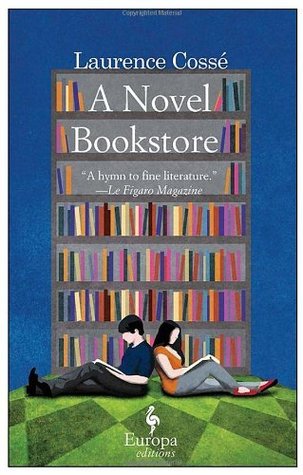
What makes a good book a truly "great" book? When does a work of individual imagination and brilliance count as a global literary treasure? And who decides what is good or not?
Laurence Cosse's delightful novel "A Novel Bookstore" attempts to define this for the reader. But in doing so, it opens more questions than it can answer, not only about the process of reading and judging the quality of what one reads (is THIS trash or literature?), but also about the ability of "good" literature to affect our everyday lives in an almost irreparable yet profound fashion. The title of this story is a double-entendre on the main plot device - a bookstore that only sells the best novels in the world. No pulp, no bestsellers, no commercial conveyer-belt products available here, sorry!
Best described as a literary-mystery-romance, the story opens with a fast paced prologue - Three seemingly ordinary people are attacked / terrorized by unknown assailants resulting in one death. What is the connection between these people? Why are they being targeted for assassination? As we look into this mysterious world through the eyes of an unnamed narrator (whose identity is revealed on the very last page), the story unfolds through the intersecting lives of the two main protagonists, Ivan and Francesca - the brains (and hearts) behind the eponymous bookstore.
Ivan is a young bibliophile who is unfortunately, also in the business of selling them. His personal taste often finds itself at odds with his employer's or worse, customer's demands, and he quickly gathers an impressive resume of short stints in various bookstores. It is in one such idyllic store in a ski station that he meets Francesca, a wealthy Parisian with a similar taste in literature and the same passion for disseminating good literature. Plans hatch quickly to open a store that sells only the best novels to their customers. The task of choosing the inventory falls on the shoulders of a committee of eight authors that they both admire. "The Good Novel" opens with the following manifesto:
“We have no time to waste on insignificant books, hollow books, books that are here to please. … We want books that are written for those of us who doubt everything, who cry over the least little thing, who are startled by the slightest noise. We want books that cost their authors a great deal, books where you can feel the years of work, the backache, the writer’s block, the author’s panic at the thought that he might be lost …. We want splendid books, books that immerse us in the splendor of reality and keep us there. …We want good novels.”
The venture opens to great success. Book lovers from far and wide flock to this unique establishment in the search for their favorites. Ivan and Francesca expand their staff, which also includes Ivan's temperamental girlfriend, to accommodate their customers better. Along the way, there are hints of romantic interest, particularly from Francesca's side, but they remain unfulfilled. Trouble brews in the form of a clandestine organization that attempts to malign the name of the new bookstore and its owners. With a media campaign that reeks of wealth, they try to portray the 'discerning' bookstore as 'elitist' and 'totalitarian.' When that fails, they try to skew the inventory by sending in hundreds of bogus customers who order novels that are not in stock, but then fail to pick them up. As a last resort, they attack and intimidate the members of the selection committee.
Do Ivan and Francesca rise above their obstacles and succeed in their dream of providing the best literature to the best readers? Who is this mysterious adversary who wants to bring them down?
Cosse provides a very interesting narrative to a plot whose novelty lies in the execution of a seemingly simple idea. The characters are very well defined, and there are times when this story does not feel like fiction at all. She takes great care to describe the character quirks, clothing, and environs in minute detail. The language is also free-flowing, and the often witty dialogues do not feel forced. However, the book tries to be many things at the same time, and nearly does not succeed. It comes off as a first-rate meta-fiction about literature, but the mystery portion is oversold and undercooked. It tries to draw a parallel between the literary and fictional worlds inhabited by the characters, but the tragedy in the character's lives does not hit home quite as hard since the relationship between Ivan and Francesca is not developed to the extent to make the tragedy a poignant denouement. The parts that are best written invariably involve discussion of books, and those are the passages that stay with you long after the story has concluded.
In all, this is an excellent story that explores the importance of books in our society on an individual as well as societal scale. Very recommended!
Tuesday, November 4, 2014
Marie C. reviews ELEVEN DAYS by Stav Sherez

When it comes to series, I rarely read past volume one. It's not that I'm anti-series; I just usually don't get hooked enough to continue, and in the case of crime fiction, I'd rather sample lots of series than delve too deeply into one. It's a way for me to get to know a little about a lot of authors and stories, so that I can recommend books approrpriately to my customers and friends.
Eleven Days is book two of British writer Stav Sherez's Carrigan/Miller series, so you can tell right away I'm a fan. The first book in the series, A Dark Redemption, was a favorite of mine in 2013, one of the best books I read that year of any genre and Eleven Days is a worthy successor. After finishing the second installment, I'm confident this series has a bright, dark future.
Set again in London and featuring his detectives Jack Carrigan and Geneva Miller, we start out with ten dead nuns and one other dead person in a London convent. Police find their charred bodies after fire tears through the building and little by little clues emerge. The nuns have connections to bad guys in South America and Eastern Europe- lots of people who'd like to see them dead, for different reasons. Several of the bodies bear the marks of torture. Financial records point towards work in South America and ties to the leftist liberation theology movement. The nuns also had run-ins with Albanian drug lords and sex traffickers next door. And the church itself is not being particularly cooperative with our investigators. We also see more developments in Carrigan and Miller's ongoing rapport and hints that there are serious problems in Miller's personal life as well as Carrigan's. We see them pursuing different tracks of the investigation and coming to conflict with each other over theories and execution, so to speak.
Just like A Dark Redemption, Eleven Days is a great page-turner. It's grisly and gory and delves into not one but two troubling aspects of modern geopolitics, as well as the more prosaic, and tragic, story of a girl who thought she could make a difference in the world. There's enough here for three books, and Sherez weaves it all together into a cohesive and absorbing tale. I like that we got some hints about Miller's troubles, and I hope to read more about that lousy ex of hers in a future installment. I'm also glad that there doesn't seem to be any romance in the offing for Carrigan and Miller, at least in the short term. Romance plots are a distraction from the far more interesting questions of how to simply get along with other troubled human beings.
Anyway as you can tell I enjoyed Eleven Days quite a bit. I'm definitely hooked as far as following the rest of the books, however many Sherez has planned. I'm still kicking myself a little for waiting for the US release and not buying it when I was in London last year. Oh well. My next trip to London will be in September 2015 and if he's got a new one out by then I won't be waiting!
Tomorrow I'll have an interview with Sherez on my blog, www.bostonbibliophile.com.
This is my 12th book for the 2014 Europa Challenge.
I received my copy of Eleven Days for review from Europa Editions.